
 5 min read
Review the assembly in its finished condition
Imagine a sleeve locating inside a housing while its bore guides a separate shaft. The outside diameter, bore and shoulder form three different interfaces. A general coating note leaves open which surfaces receive treatment and when their dimensional limits apply. Put the finished assembly condition on the drawing and identify the mating-part revision. This illustrative review concerns smooth locating surfaces; thread gauge acceptance needs its own specification. An acceptable uncoated sample should not silently become approval of the coated production part.
Do not use one allowance rule for every treatment
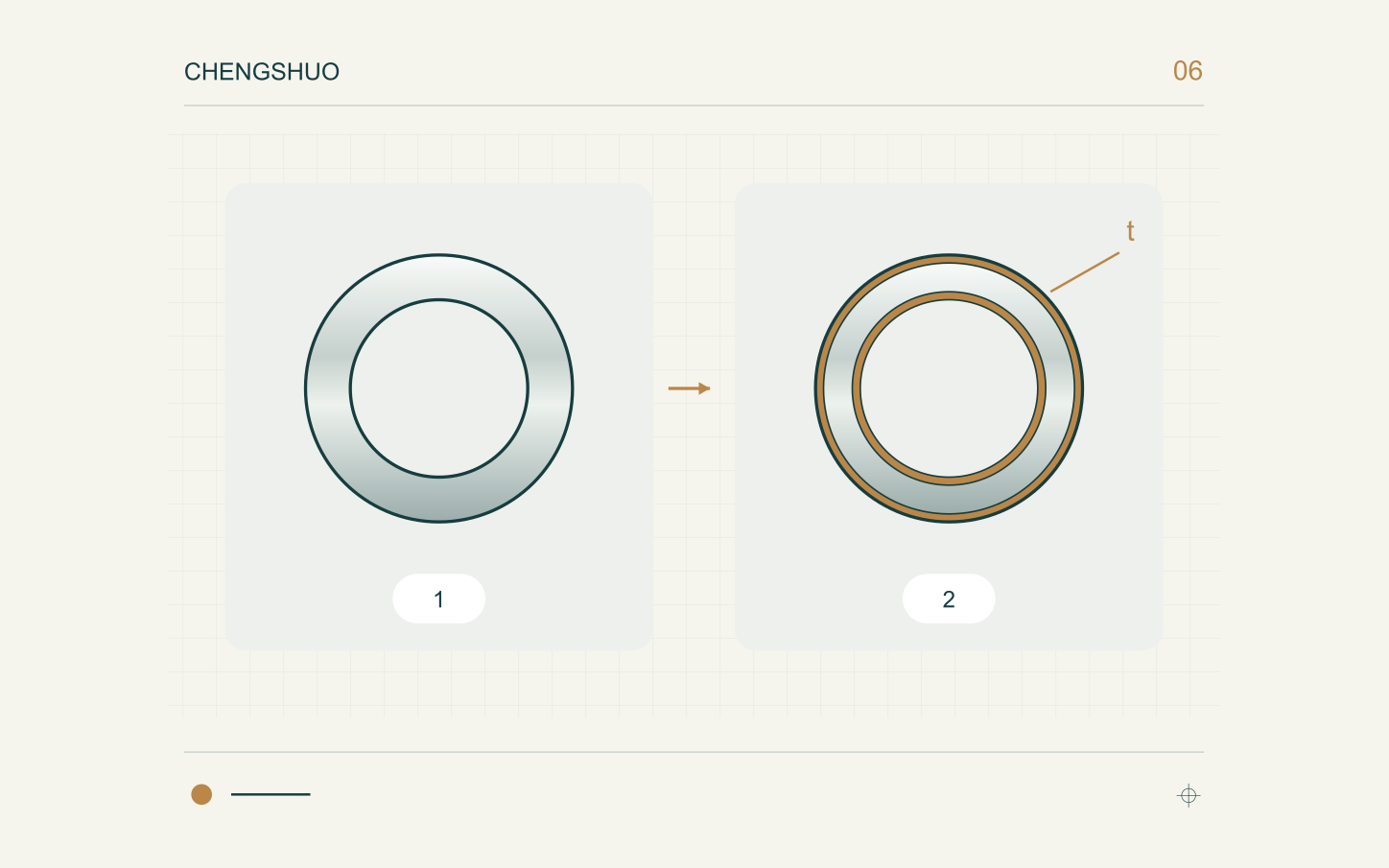
Plating deposits a layer; anodizing converts the aluminum surface into an oxide coating. The Aluminum Anodizers Council explains that dimensional change depends on process conditions and alloy, and that pretreatment such as etching also affects the result. Coating thickness therefore cannot be treated as a universal dimensional-growth allowance across processes. Provide the actual material, treatment specification and required finished dimensions to the finishing provider. Obtain a part-specific allowance proposal, including its assumptions, before fixing the machining dimensions. Do not infer treatment or thickness from colour.
Give each coated or masked region a boundary
Create a surface map: F1 for the guide bore, F2 for the external locating diameter and F3 for the seating face. State the treatment requirement for each region, including any masking. Locate the transition between treated and untreated areas relative to a drawing reference, especially near an entry edge or shoulder. Agree permitted rack-contact locations and appearance exclusions. PMPA's plating guidance highlights both coating-thickness measurement locations and rack marks. A note saying mask bore needs clarification if the counterbore, chamfer or adjacent face has a different requirement.
Assign the checks on both sides of the finishing step
Separate the machining acceptance record from the final delivered-part record. Identify who supplies the finishing instructions, who measures the affected dimensions after treatment and who resolves an out-of-limit result. If a proposal includes final machining, polishing, stripping or reprocessing after coating, obtain approval for its effect on coverage and other requirements. Keep preliminary stock allowances separate from final acceptance limits. Transfer the same surface IDs and drawing revision between providers so that a finishing certificate and a dimensional report refer to the same requirement set.
Check final dimensions and coating evidence separately
A coating record and a fit measurement answer different questions. Request the specified coating evidence at the agreed locations, then check the finished bore, journal and seating relationships against the drawing. Establish how the mating component is represented during any assembly trial. Passing a fit check does not establish coating coverage, adhesion or service life; a coating certificate does not establish the final clearance. Define any additional functional tests separately, with conditions and responsibility, rather than assuming they are included in a surface-treatment purchase.
Close the finish questions before ordering samples
Send Chengshuo the drawing, material grade, finish specification, mating-interface section and sample quantities. The sleeve and flange-seat examples below are geometry references, not evidence of a particular coating. Use this checklist to make the quotation scope clear:
- Final condition: state which dimensions apply after treatment.
- Surface map: define covered areas, masking boundaries and permitted contact marks.
- Allowance review: obtain the proposed process-specific machining basis and assumptions.
- Verification: assign final dimensional checks and coating-record locations.
- Changes: require approval before rework changes coating or functional surfaces.
FROM THE GUIDE TO YOUR PART
Put the checks into context.


References & further reading
- PMPA — Plating notes, thickness locations and rack marks

- Aluminum Anodizers Council — Dimensional change and masking
General planning guidance. Feasibility and acceptance criteria are confirmed against your drawing.