 6 min read
Choose the required edge outcome before choosing a tool
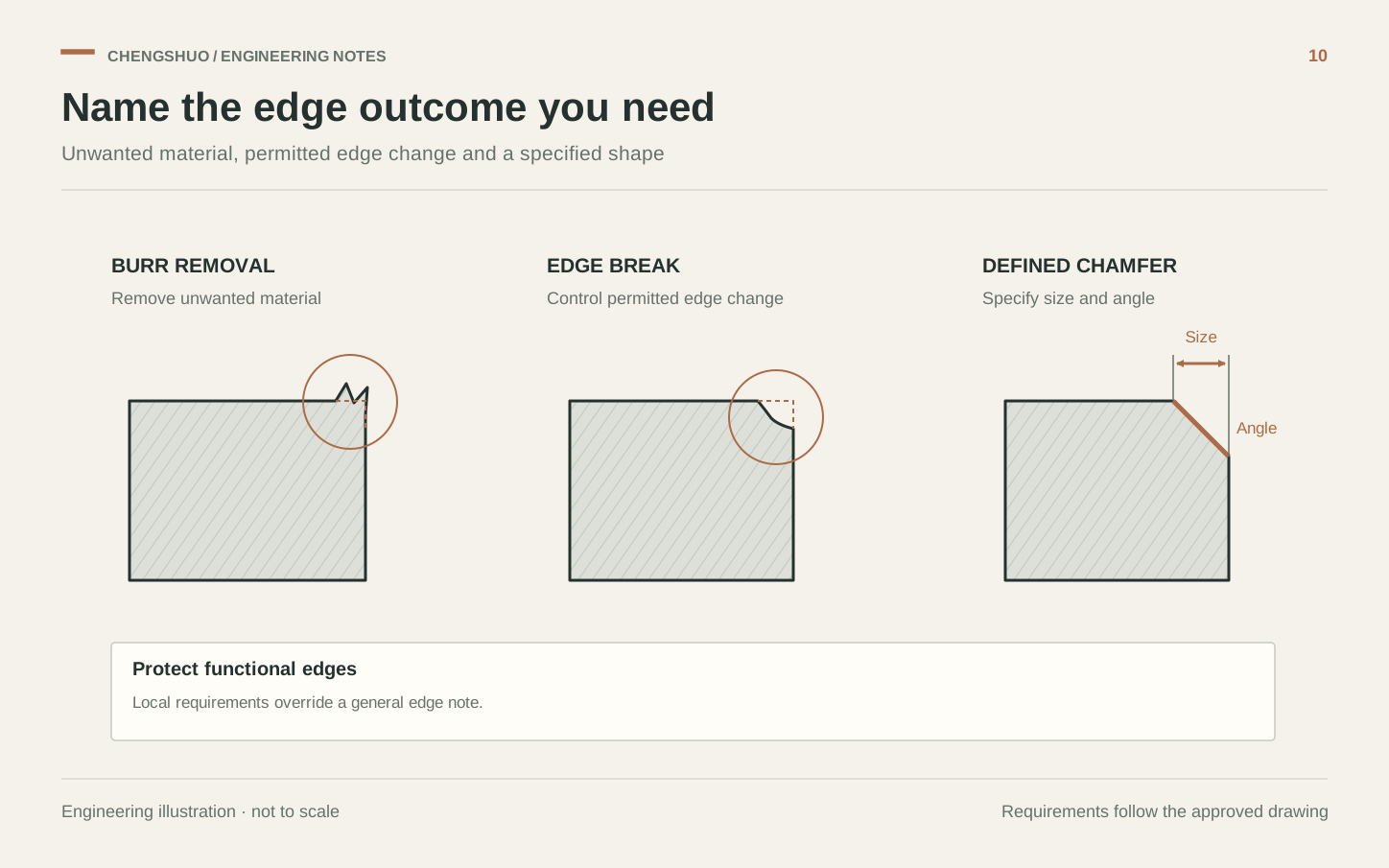
Begin with the part function and the permitted delivered geometry. Burr removal addresses unwanted material attached to an edge. An edge-break instruction needs to state what change is acceptable, while a defined chamfer needs the geometry and limits given on the drawing. Use separate characteristic references when different edges need different outcomes. This keeps a shop preference from becoming an undocumented design decision.
The public scope of ISO 13715 addresses indications for edges of undefined shape and distinguishes them from geometrically defined edges. HEULE also presents deburring and chamfering as distinct tooling applications. Use those distinctions to ask better questions; the drawing owner still chooses the applicable standard, the actual requirement and its acceptance criterion. Agree an open callout before requesting an unconditional production quotation.
Map general edges, functional edges and exceptions
Mark the edges that affect locating, sealing, sliding, assembly, handling or passage cleanliness. Identify internal intersections separately from open entrances. A broad note can remain useful for an agreed group of general edges, provided local requirements and exceptions are clear. Show the controlled locations on sections or detail views where a general view would leave their identity uncertain.
Protect the adjoining features explicitly. A bearing shoulder, a thread entry, a thin wall and a metering edge may require different permitted changes. State whether a local chamfer is intentional, whether a contact land must be retained and where material removal must stop. Avoid asking the supplier to decide which surface may be changed simply because several locations look similar on a rendering.
Connect the edge requirement to the delivered condition
State which manufacturing stage the acceptance requirement applies to. Include the specified coating, treatment or later operation when it affects the finished edge. Ask the supplier to identify how the proposed route addresses access and preserves the protected surfaces. Keep the process proposal separate from the drawing outcome so an alternative tool or route can be reviewed without changing the accepted part definition.
Define loose-particle, cleaning and packaging requirements as additional items when the project needs them. An edge inspection result should not silently become evidence for an unspecified cleanliness or functional test. Put each requested check and record into the same enquiry package. Quotation review can then confirm which operations are included and which decisions remain open before samples are made.
Agree inspection by location and characteristic
Identify what must be observed or measured at each controlled edge. For a dimensioned chamfer, connect the result to the drawing geometry and selected method. For another permitted edge condition, agree the assessment method and scope with the inspection specialist. Include internal viewing access, surface preparation and relevant evaluation conditions in the method record rather than relying on the instrument name alone.
Use sample identities and drawing characteristic numbers to connect results to parts. If an image is requested, identify its location and viewing direction. If a destructive sample or another special method is proposed, agree how it supports the lot acceptance plan. Preserve original results and quality dispositions. A retouched image or a favourable reading from an unidentified location is not a replacement for the agreed record.
Put the drawing and quotation decisions on one worksheet
The worksheet is a purchasing aid. Fill it from the approved drawing and the project decisions made with the design and quality teams. It does not prescribe one universal edge size or a supplier capability. Use a marked view to distinguish the edge groups and connect each row to the sample evidence required for release.
Consider a representative sleeve with a locating shoulder, an assembly entrance and an intersecting side hole. Give the shoulder a protected contact region, define the entrance geometry needed for assembly and identify the internal intersection for its own edge and inspection requirement. The purchasing benefit is a quotation that covers the actual locations and checks, with less room for different assumptions between suppliers.
| Decision | Agree before ordering | Retain with the order |
|---|---|---|
| Edge identity | General group or named local edge | Marked drawing and revision |
| Required outcome | Burr removal, permitted break or defined geometry | Approved criterion |
| Protected area | Functional face and removal boundary | Detail or section view |
| Delivered condition | Treatment, cleaning and packing scope | Agreed process and order scope |
| Inspection | Location, method and coverage | Traceable sample result |
| Repeat release | Changes and approval responsibilities | Retained sample/order basis |
Close the enquiry and keep the approved basis for repeat orders
Send Chengshuo the current drawing, material and final surface specification, quantity scenarios and the marked edge locations. State the sample and later-lot records required. Request separate identification of optional finishing, cleaning or inspection work so the delivered scope can be compared. Where the supplier proposes a change, obtain the drawing owner's decision and preserve it before production.
Before a repeat order, compare the drawing revision, edge exceptions, final treatment and acceptance method with the approved sample basis. Review changes to an internal passage, mating component or protected face. Keep concession and rework decisions traceable to the affected lot rather than turning them into an assumed permanent requirement. Use the retained records to make the next order specific and reviewable.
Questions before your drawing review
Does break sharp edges specify one chamfer size?
Use the complete drawing requirement. A broad edge note needs its permitted outcome and exceptions clarified; a geometrically defined chamfer should carry the actual geometry and limits selected for the part.
How should functional edges be treated?
Identify them locally, state the required edge condition and protect the adjoining features. Connect each controlled location to the agreed inspection scope rather than relying only on a global note.
When should the edge be inspected?
Specify the delivered condition and inspection stage, including any final treatment or later operation that affects the edge. Record the method and part condition with the result.
Are burr removal and cleanliness the same check?
Set edge geometry, attached material, loose-particle or cleanliness requirements and functional tests as separate items where required. Give each requested result its agreed method, criterion and evidence.
What should the supplier include in the quotation?
Include the identified edge work, final treatment, inspection records, cleaning and packaging required by the enquiry. Show optional operations separately and resolve open drawing decisions before production.
What should be retained for repeat orders?
Retain the drawing revision, edge-location map, approved conditions, inspection method and sample or lot records. Review changes and keep any concession or rework approval tied to its actual scope.
Prepare the drawing review
- Internal cross-hole acceptance
- Inspection scope and records
- Material and finished-surface specification
Technical references: ISO 13715 — scope of undefined edges, HEULE — deburring and chamfering tools.