

Content prepared on
Buy a finished component with a defined interface
A tubular part is usually purchased for the surfaces that locate, support or connect it within an assembly. Begin the enquiry with the finished component drawing and its revision. Show the outside form, internal profile and end faces together, rather than sending only a tube diameter and cut length. Identify which dimensions control the mating relationship and which dimensions provide clearance.
Separate the part you intend to order from the surrounding assembly. If an adjacent housing, shaft or connector helps explain a feature, include a labelled assembly view and state whether that item is supplied by you. This gives the quotation review a clear boundary: the delivered component, its required condition and the interfaces that must be checked.
Compare two real reference routes
Chengshuo's brass pipe-sleeve reference is published as CS2024053 and identifies brass and CNC machining. Its sleeve and shoulder geometries provide a starting point for discussing a locating bore, an outside fit or an axial seating feature. Give each requested variant its own drawing identifier so similar-looking sleeves can be quoted and inspected as separate order positions.
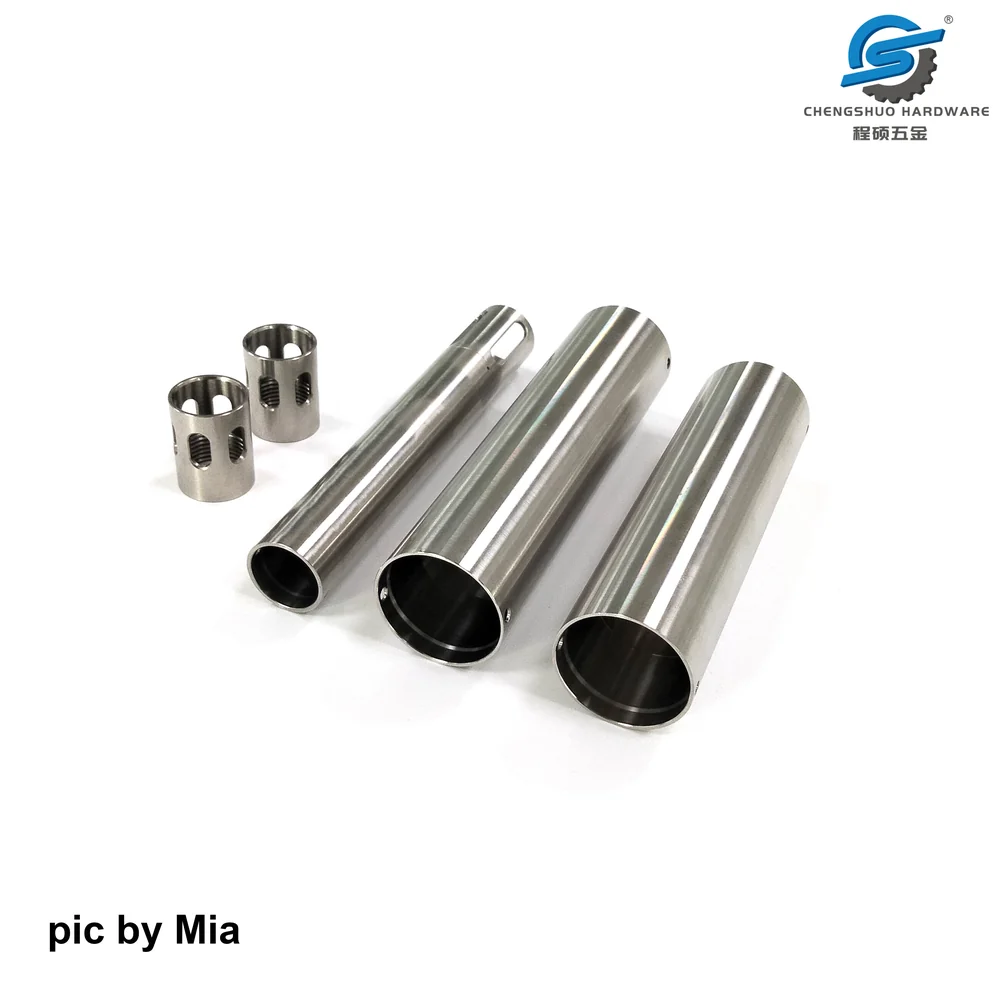
The stainless steel tube-component reference shows a different tubular geometry and is published with stainless steel as its material. Use that reference when describing a tube body with openings or end details, then mark the features required in your drawing. Select the actual material designation and delivery condition during technical review. These examples support a concrete discussion of the part you want to buy.
Specify inside and outside geometry together
State the bore and outside dimensions with their individual limits. Where their relationship matters to assembly, show the relevant geometric requirement and datum arrangement. Mark the axial length over which a fit or surface requirement applies. A stepped bore, shoulder or local recess should be visible in a section view so the quotation covers the intended finished geometry.
Identify wall-sensitive areas and the agreed inspection condition. If the component is measured freely, supported or assembled against another part, describe that condition in the enquiry. Ask the supplier to explain the proposed manufacturing and checking approach for the actual drawing. Keep any starting-stock preference separate from the finished-part requirements so a proposed route can be reviewed explicitly.
Define tube ends, openings and edge condition
For each end, show the required face, lead-in, shoulder and any thread or recess. Specify thread designation and engagement requirements where applicable. Use a view that makes an internal feature accessible to the drawing review. If the two ends differ, identify them consistently in the drawing and the inspection worksheet rather than relying on an unlabelled photograph.
For lateral openings, include the axial location and any angular relationship to another feature. Mark edges that require an agreed acceptance condition, including edges reached from inside the bore. If cleanliness or protection is relevant to your assembly, request a defined condition and the associated records. This makes the requested finishing and handling scope part of the quotation.
Plan samples around the way the part is accepted
Choose the characteristics that must be recorded for sample approval and give each one a drawing reference. Describe the expected record, the relevant part condition and any identified mating piece used in a trial assembly. A bore measurement, a thread check and a fit trial can then be assigned their own result and acceptance rule.
List open technical questions before placing the order. Agree how a drawing change or a changed material condition will be reviewed and recorded. For repeat purchasing, retain the approved drawing revision with the agreed inspection scope. This keeps the sample decision connected to the version ordered later and allows changed features to receive a deliberate review.
Request comparable quantities and delivery documents
Send a sample requirement and production quantity options as separate lines. Include material designation, requested surface operations, marking and packing instructions where needed. Name the documents required with the parts, such as the agreed dimensional record or material documentation. Ask for each additional requirement to be included in the proposed scope rather than assuming it is covered by a general unit price.
Use the reference links below to identify the closest geometry, then send your own drawing and the outstanding questions to Chengshuo. Tell us which interfaces determine assembly and which records your purchasing or quality team needs to review. The resulting enquiry gives the quotation a clear component scope, revision and basis for sample approval.
Enquiry and parameter worksheet
| Item | Reference and specification |
|---|---|
| Brass sleeve reference | Brass; CNC machining is stated in the CS2024053 source. Define the bore, shoulder and outside interface for your own part. |
| Stainless tubular reference | Stainless steel is stated in the published tube-component source. Define openings, end details and delivery condition. |
| Critical dimensions | Provide feature-specific limits and geometric requirements from the controlled drawing. |
| Sample acceptance | Specify the measurement condition, required records and any identified mating-piece trial. |
Reference parts and drawing resources
- Brass pipe sleeves
- Stainless steel tube components
- Tube clamping and inspection state
- Prepare a machining enquiry
Procurement questions
What information is needed for a tubular-component quotation?
Send the current drawing, material designation, quantity options and delivery condition. Mark the bore, outside surfaces, end details and records that determine acceptance.
Are brass and stainless steel shown in Chengshuo's references?
Yes. The linked brass pipe-sleeve and stainless tube-component pages identify those materials. State the exact designation required for your own order.
Should I specify tube stock or the finished geometry first?
Define the finished component first. If a particular starting-stock route is required, state it separately and include the documents needed to review that route.
How are wall-sensitive features reviewed?
Identify the affected regions and the condition in which their requirements apply. Agree the support or assembly state used for inspection and sample approval.
Can tube ends and lateral openings be included in one enquiry?
Show each end and opening on the same controlled drawing, including location, angular relationship where needed, edge condition and the intended checking scope.
What is useful for a repeat order?
Retain the approved drawing revision, material condition and inspection agreement. Identify subsequent changes so the affected requirements can be reviewed before production.